 Ten years ago, we registered a company around a radical idea: applications are graphs. Today, Graphileon is a multi-database, AI-enhanced low-code platform used by government bodies, healthcare organisations, pharmaceutical companies, and manufacturers across three continents. This is not a history lesson. It’s a statement of where we stand, and where we’re heading.
Your app is a graph — and that changes everything
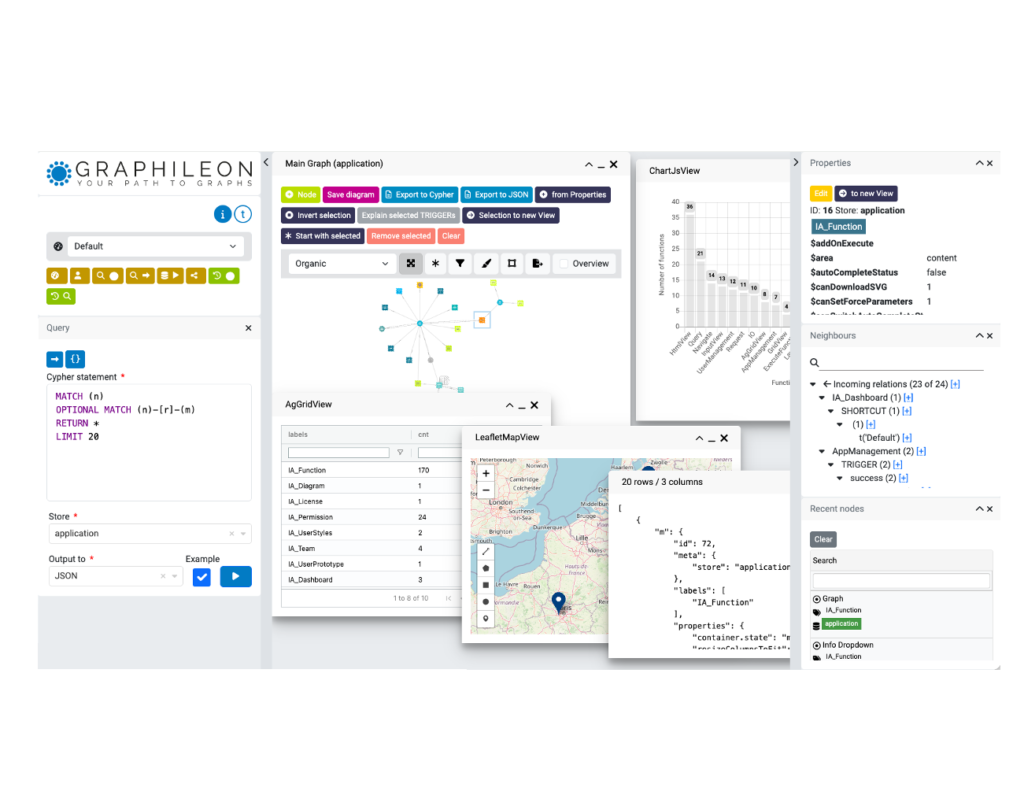
At the heart of Graphileon lies a deceptively simple idea that has proven remarkably durable over a decade: applications are graphs. In our Function-Trigger Infrastructure (FTI), every component of an application, every grid, chart, map, query, form, and API call, is a node in a graph. The connections between them (what happens when a user clicks a row, submits a form, or a query returns results) are relationships. The entire application can be visually inspected, modified, debugged, and versioned within the same environment used to run it.
This is not just a visualisation tool. It’s not a dashboard builder. It’s a native graph low-code platform, a rapid application development environment where business consultants, analysts, and engineers can build sophisticated, multi-database graph applications without writing traditional code. The platform ships with over 60 standard functions: from AgGridView and ChartView to MapView, TimelineView, CalendarView, advanced and dynamically stylable network visualisation, InputView forms, and backend operations including Query, API, Email, ShellExecute, Hash, and WebSocket.
What makes this approach different from generic low-code platforms is that graph thinking permeates every layer. Role-based access control is managed as a graph. Application modules are reusable graph patterns. Multi-database queries can span Neo4j, Memgraph, and FalkorDB endpoints simultaneously. As one of our partners put it: “We found in Graphileon an application architecture based on graphs themselves, with a model-driven, no-code approach that is very sophisticated, far beyond graph visualisation.”
A small and proud team with a global footprint
We have always operated as a lean, distributed team of motivated and creative specialists working from locations that inspire them. A core development team spanning the Netherlands, Romania and Turkey, together with a partnership ecosystem that allows us to punch far above our weight class.
Since its conception, every member of our team has left their traces. Making Graphileon more robust, secure, versatile, performant, easier to understand by challenging each other, by proving that there is always more than a single way to do things. The result: a happy and proud team that continues to amaze customers by the speed with which functionality can be delivered.
In 2016 we already said: “In today’s world, where business value is created by rapidly extracting information from connected data, graph databases are essential.” That conviction has only deepened over the past decade, and the market is finally catching up.
Where the next decade leads
The graph technology landscape in 2026 looks nothing like it did in 2016. Graph databases have moved from niche academic tools to mainstream enterprise infrastructure. Knowledge graphs power search engines and recommendation systems. Vector search and retrieval-augmented generation have made graphs essential to the AI stack. Streaming graphs enable real-time pattern detection at scale.
Graphileon has anticipated and adapted to each of these shifts — adding multi-database support before it was fashionable, integrating AI before most graph tools had heard of embeddings, and connecting to streaming platforms while others were still debating batch processing. The platform’s recent integration conversational AI, streaming graphs, workflow automation, and external script execution is an expression of our vision of becoming a connected intelligence layer sitting between graph databases, AI models, external APIs, and human decision-makers.
Graphileon was born from the desire to provide “tools to people who want to create business value, but who cannot code.” A decade in, that mission has expanded but not wavered. The company’s stated vision is clear: “Graph technology will become mainstream and be part of the standard toolset of the majority of organisations, in addition to legacy tools like relational databases and spreadsheets.”
A decade of building bridges between data and decisions
Tom Zeppenfeldt, CEO : “When I look back, I realize that what makes our ten-year story remarkable is not just the technology. It’s the consistency of vision. Across government, healthcare, pharma, manufacturing, and beyond, the thread has always been the same: make connected data accessible to the people who need it, without forcing them to become programmers.”
The “application is a graph” insight has proven not just durable but prescient, as the industry increasingly recognises that graph thinking must extend beyond the database into the application and context layer itself.
Ten years of steady innovation. A growing ecosystem of partners and customers. A platform that now spans low-code development, multi-database connectivity, AI integration, and real-time streaming, all from a small team with a big idea.
In a technology landscape dominated by hype cycles and pivots, Graphileon’s decade of focused, purposeful building stands out.
The next ten years, with graph technology finally entering the mainstream, may prove to be even more consequential than the first.

 Docker
 Cloud
Cloud